
Signs a tree may fail
The N.C. Forest Service's guide to assessing storm-damaged trees, written for towns and the people who care for their trees, is plain about when a tree should go. Its recommendations translate well to a back yard:
- Half the crown gone. A tree that has lost 50 percent or more of its live crown should be removed.
- A split trunk. Where two stems of similar size split down into the trunk, the trunk is structurally compromised and the tree should come down.
- Lifting roots. Root zone lifting and cracked soil call for removal.
- Hangers. Broken branches hung up in the crown should be taken down, even if the tree stays.
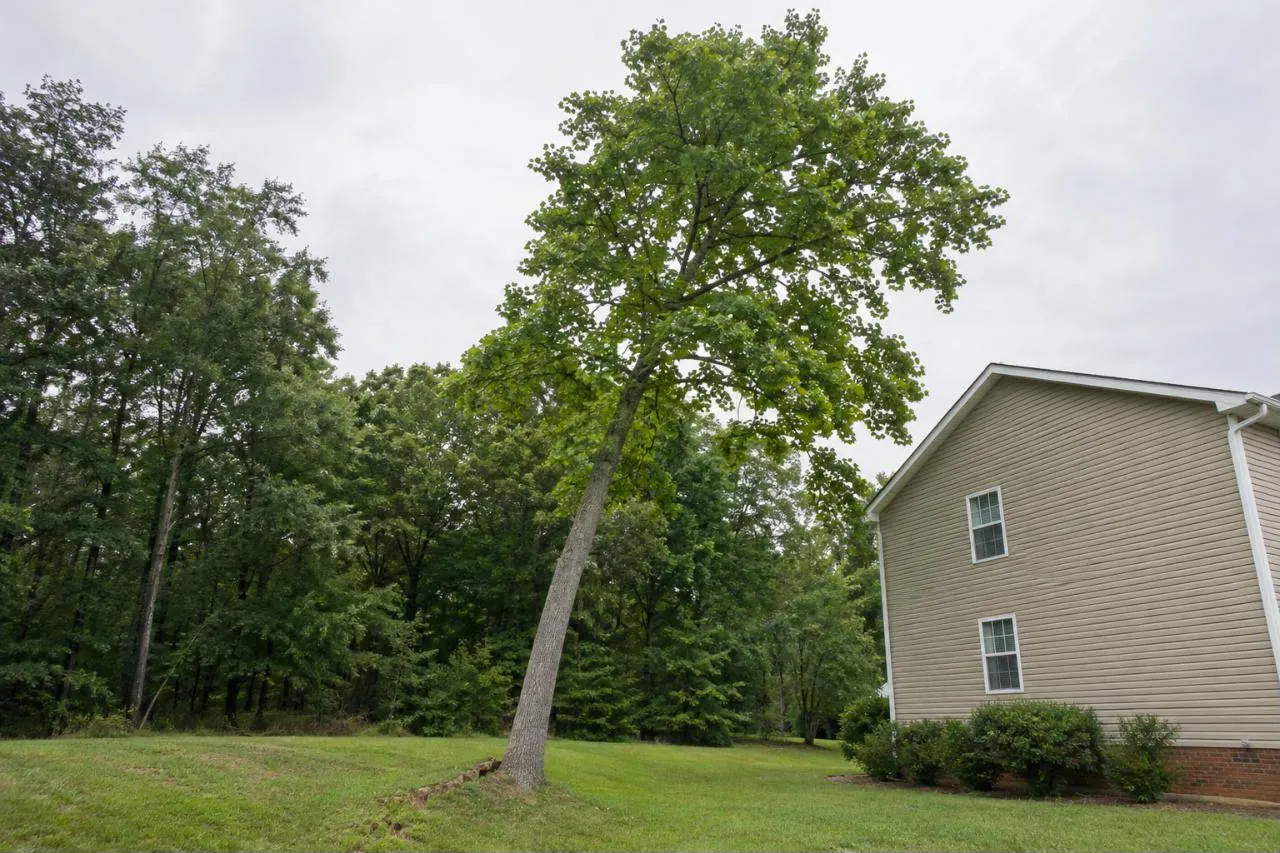
- A steep lean. A tree leaning about 30 degrees or more deserves a close inspection.
NC State Extension's storm-damage page reaches similar conclusions for home landscapes. It recommends removing trees with more than half the canopy damaged, trees with major broken limbs or a broken central leader, and large, leaning trees. For a small tree whose leader and main branches are intact, it leans toward keeping it, and when the call isn't clear and nothing is in immediate danger, it suggests waiting and looking at the tree again in a few months.
Leaning trees
A lean by itself isn't the problem. The Forest Service guide says not all leaning trees are a safety risk, and that one thing to check is whether the tree has been correcting itself, with its upper trunk and crown growing back toward vertical over the years.
The warning signs are in the soil. The guide points to mounding of soil around the base of the tree on the side opposite the lean, and to cracks in the soil on that side, especially together with mounding. Those mean the root plate is lifting. A lean that showed up after a storm or a week of heavy rain, with the ground heaved on the far side, is the kind to have looked at right away, before the next wind finishes the job.
Pines that fade
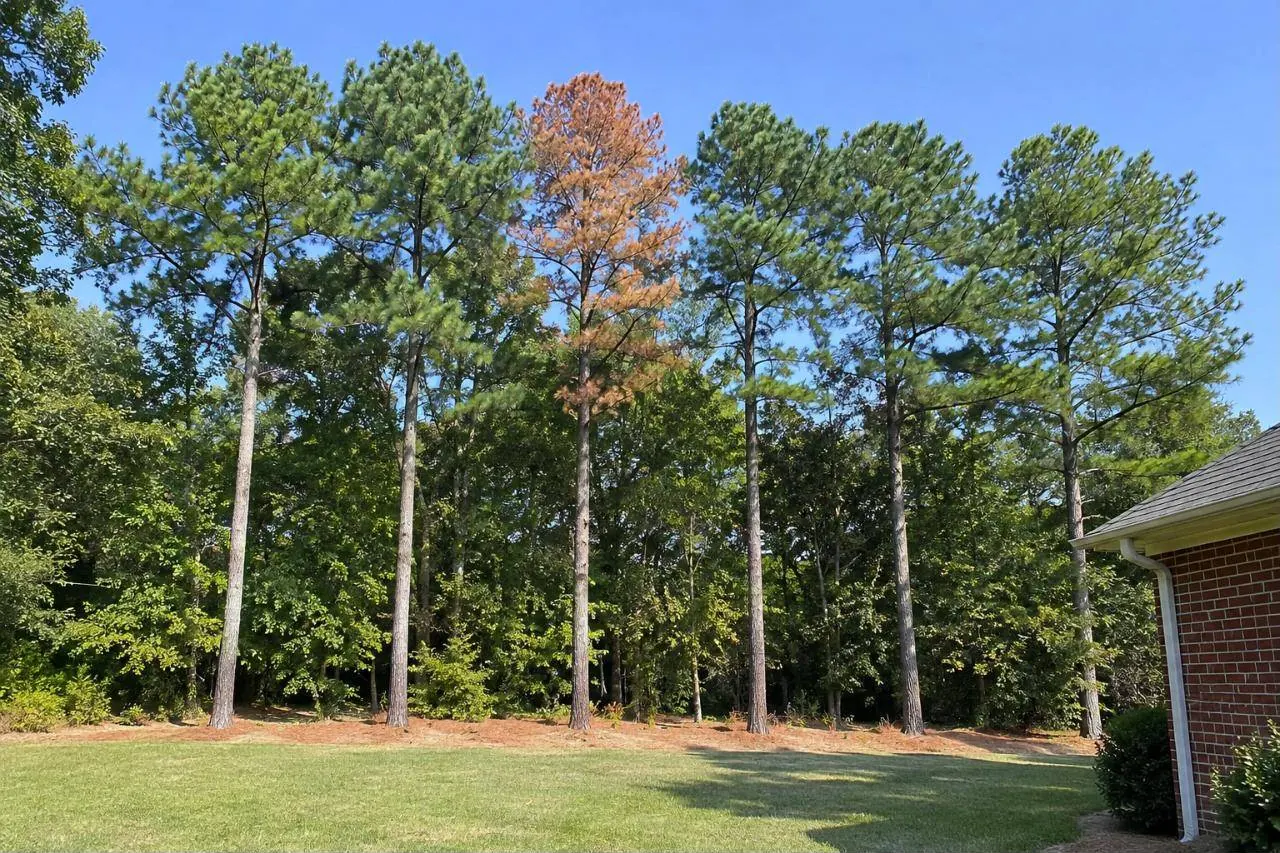
A pine whose crown turns off-color has often been hit by bark beetles. NC State Extension's publication on pine bark beetles, by extension specialist Kelly Oten, names the three groups that attack southern pines: the southern pine beetle, Ips engraver beetles and the black turpentine beetle. During an attack, it says, the needles fade from green to light green, to yellow, to red.
- Pitch tubes. Small blobs of resin on the bark are a good sign that bark beetles are attacking, though not of which kind.
- Stress first. The beetles mainly go after pines already weakened by something else. For Ips, the publication lists drought, crowded stands, storm or fire damage and lightning strikes; black turpentine beetles favor freshly wounded trees, including ones hurt in storms.
- Loblolly is a target. The USDA Forest Service's species review says loblolly pine is severely attacked by the southern pine beetle.
A dead pine next to the house, the drive, a play area or the road is a removal to schedule soon. The pine guide covers beetles and tall pines in more depth.
Short-lived oaks and weak poplars
Two big trees often seen around Louisburg come with warnings from NC State's plant database:
- Water oak. It may live only 30 to 50 years, and its limbs are "notoriously weak," at risk in high winds and in winter snow and ice. An old water oak dropping dead limbs over the house deserves a close look.
- Tulip poplar. Fast growth makes it weak-wooded and prone to losing limbs in wind, ice and snow. It also has a shallow root system and can reach 80 to 120 feet.
Don't judge a poplar by one dry August, though. NC State notes that tulip poplar is sensitive to heat and drought and that in hot, dry weather its leaves tend to turn yellow and drop, so some yellow leaves in a drought are normal for this tree.
White oak is long-lived and slow-growing, by NC State's account, though the same entry lists it as susceptible to wind damage and sensitive to soil compaction. If a driveway, an addition or a septic repair went in near a white oak, mention it when the tree is looked at.
A neighbor's dead tree
If a dead or leaning tree next door threatens your house, start with a conversation. If it later falls on your home, the Insurance Information Institute's 2010 guidance says the claim goes on your own policy, and your insurer may seek repayment from the neighbor's insurer, which sometimes happens when the tree was in poor health or not properly maintained. Photos of the tree's condition, dated, are worth having.
For a dead tree on town property in Louisburg, call Town Hall at (919) 496-3406. For one in the right-of-way of a state road, call NCDOT Customer Service at 1-877-368-4968.
What commonly goes wrong
- Waiting for the next storm. A fresh lean with heaved soil, or a split trunk, won't get better.
- Reading a fading pine too late. The red crown is the last stage, not the first.
- Removing a healthy tree out of worry. A long-standing lean that has corrected itself may be fine. Have it looked at before deciding.
- Climbing a dead tree. Ask how the contractor plans to take it down, especially a dead pine.
- Cutting by the creek without checking. The state's Tar-Pamlico buffer rule, which covers most of the county, has its own entries for removing dead, diseased, damaged and dangerous trees within 50 feet of mapped streams and ponds; in parts of the south of the county the Neuse buffer rule applies instead. Ask a buffer permitting specialist at the Division of Water Resources, (919) 707-3631.
Questions homeowners ask
My pine's needles turned brown. Is it dead?
It may be. NC State describes the color change during a bark beetle attack as green to light green to yellow to red. Have it looked at, and if it stands near the house, plan its removal soon.
Is a leaning tree always dangerous?
No. The Forest Service guide says not all leaning trees are a risk. Mounded or cracked soil on the side away from the lean is what turns a lean into a warning.
Do I need a permit to remove a dead tree?
For a tree at an existing home, the town and county ordinances read for this site don't list one. The exceptions worth checking are Louisburg's historic districts and trees near streams and ponds. See the rules guide.
Can a damaged tree be saved?
Sometimes. NC State suggests keeping small trees whose leader and main branches survived, and the Forest Service guide treats broken hangers as something to take out of a tree rather than a reason to take the tree down. A contractor can tell you which case yours is.
Requests about a dead or leaning tree go to one independent contractor who works around Louisburg. This website does no tree work.
- N.C. Forest Service, Urban and Community Forestry, Storm-Damaged Tree Assessment Best Management Practices.
- NC State Extension, Preventing and Managing Storm Damage to Trees; Pine Bark Beetles (K. Oten, August 4, 2022); Plant Toolbox entries for water oak, tulip poplar and white oak.
- USDA Forest Service, Fire Effects Information System, Pinus taeda (Carey, 1992).
- Insurance Information Institute, guidance on insurance for fallen trees (2010). 15A NCAC 02B .0734 (Tar-Pamlico buffers) and 02B .0714 (Neuse buffers).