
Grind it, dig it or leave it
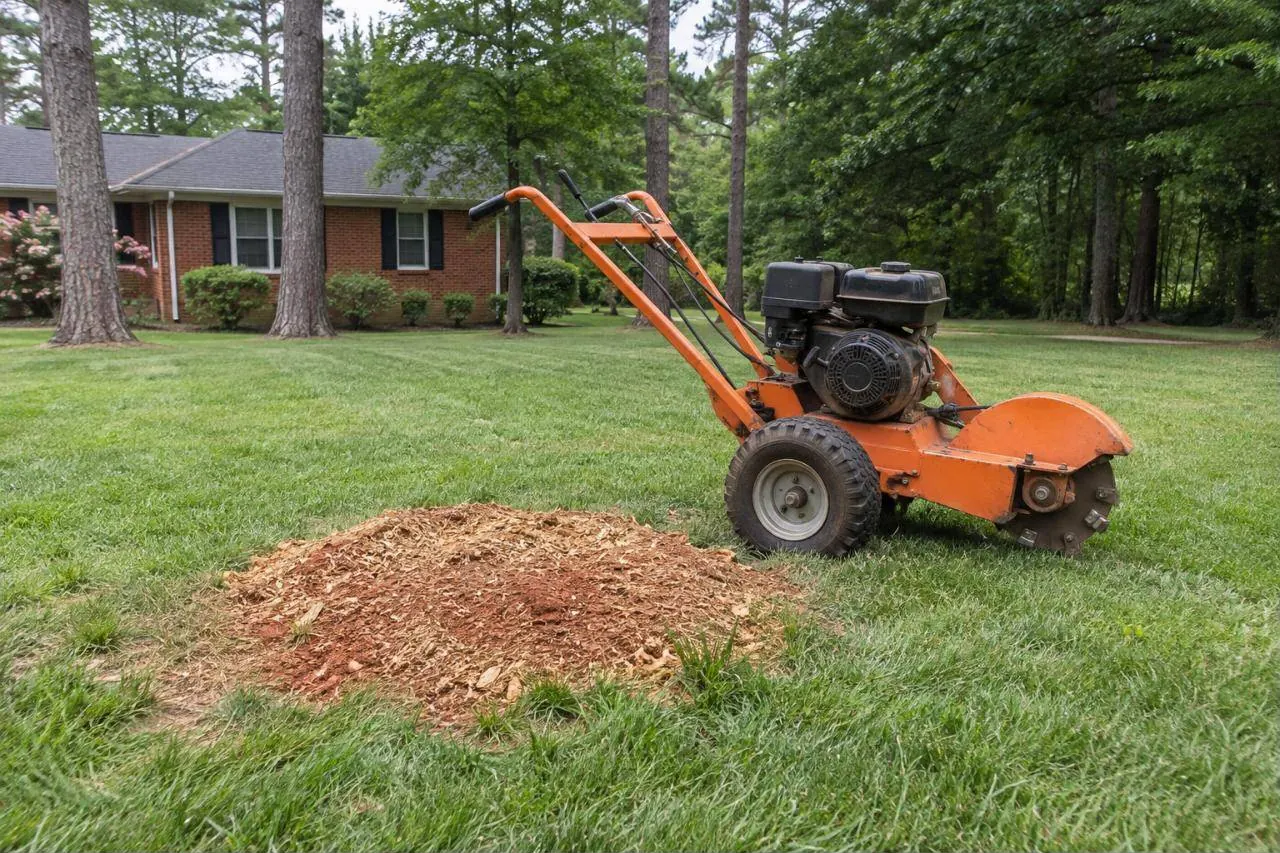
A stump grinder carries a heavy wheel ringed with cutting teeth. The operator swings it back and forth over the stump, shaving the wood down a little at a time until it sits below the surface. The roots stay in the ground and rot over time, and the lawn around the stump is left mostly in one piece. For a finished yard it's the usual choice.
Digging the stump out with an excavator or backhoe pulls up the stump and its root ball together. The hole is far bigger and more of the yard gets torn up, but the wood is gone. That matters where something solid will sit on top, such as a slab, a driveway, a shed pad or an addition, because buried wood rots and the ground above it sinks.
Leaving the stump a few inches high costs the least. It also leaves something to mow around and trip over for years.
NC 811 before the grinder
North Carolina's underground damage prevention law defines excavation as an operation that moves or removes earth, rock or other material in or on the ground, and it expects notice to the state's 811 center no less than three full working days before digging starts. Weekends and state holidays don't count. Call 811, or 1-800-632-4949, and utility owners mark their public lines.
The law's notice requirement exempts digging done by the owner of a single-family home on their own land, as long as it stays off a utility's right-of-way or easement. A grinder operator you hire isn't the owner, so ask whether they've placed a ticket and wait for the marks.
Know what 811 won't find. NC811 says private lines on private property aren't marked, and as long as they don't encroach on a utility's right-of-way or easement, the law's definition of an underground facility leaves out septic tanks, swimming pools and irrigation systems. On a rural lot that can mean a septic tank and drain lines, a water line from a private well, and a buried wire out to a shop or barn. Walk the crew around them before the grinder starts.
Chips, soil and settling
Grinding leaves a mound of chips mixed with soil, and a bowl where the stump stood. The chips are mostly wood, and wood shrinks as it rots, so a hole filled back with chips alone will sag.
- Rake most of the chips out of the hole. Spread them as mulch in beds or on paths, away from the foundation.
- Fill the hole with topsoil, tamp it, and leave it a little proud of the lawn.
- Seed or sod the spot to match the rest of the yard.
- Add soil again after a few months, as the roots below decay and the patch settles.
Ask whether the price covers raking, hauling off the extra chips and bringing in fill, or whether the crew grinds and leaves.
Stumps the towns won't take
Don't count on the curb. Louisburg's solid waste policy lists tree stumps and large root balls among the things its yard-waste crews won't accept. Franklinton's public works page says plainly that stumps won't be picked up. Outside town limits, Franklin County doesn't collect waste at the curb at all.
Burning has limits too. The state air rule lets a homeowner burn leaves, logs, stumps, branches and yard trimmings that come from their own residence, but only where no public pickup is available. Louisburg, Youngsville and Franklinton all pick up yard waste, so inside those towns that condition generally isn't met; ask the town before burning anything, stumps included. See the burning rules.
Stumps by a creek or pond
Within 50 feet of a stream, lake or pond shown on the county soil survey or USGS maps, a state buffer rule applies: the Tar-Pamlico rule over most of the county, or the Neuse rule in parts of the south. For a tree taken down because it threatens a house, the Tar-Pamlico rule lets the stump be left or ground in place as long as no more ground is disturbed, so pulling it out isn't part of that allowance. Before grinding or pulling a stump in that strip, ask a buffer permitting specialist at the Division of Water Resources, (919) 707-3631.
If the tree is still standing
The stump comes after the tree. Grinding during the same visit as the removal saves bringing the machine back, so ask for both in one price. See tree removal, and for pines near the house, pine tree removal.
What stump grinding costs
Thumbtack's tree removal cost guide, last updated March 24, 2026, prices grinding alone, after the tree is already down, by the width of the stump:
| Stump width | National range, Mar 2026 |
|---|---|
| Less than 12 in. | $267 to $354 |
| 12–24 in. | $324 to $443 |
| 24–36 in. | $355 to $486 |
| 36–48 in. | $372 to $494 |
Elsewhere in its text, the same guide gives average grinding costs of around $307 to $426, a range that doesn't quite match its own table. Both are national figures. How easy the stump is to reach, how many there are, surface roots and cleanup all change a Franklin County price, and the contractor's written number is what you'd pay.
Where grinding goes wrong
- No 811 ticket. A grinder cuts below the surface, where service lines run.
- Private lines. A well line or a wire to the shop near a stump is easy to chew through. Mark them first.
- Flying chips. A grinder flings chips and stones with real force, so move cars, keep children and pets inside, and shut the windows nearest the stump.
- Too shallow for what comes next. Grass needs less depth than a new tree or a slab, so settle the depth in writing.
- Chips left in the hole. As they decay, the patch sinks.
When this isn't the right guide
If a building, slab or driveway will go over the spot, ask about digging the stump out instead. If you're clearing acreage for a house, the stumps are part of land clearing, a heavier job with its own equipment. If the tree is still up, start with tree removal.
Questions homeowners ask
How deep will the stump be ground?
That turns on the grinder and on what you plan for the spot. Tell the contractor whether you want grass, a flower bed or a new tree in that spot, and get the depth in writing.
Will the roots keep growing?
Some trees send up sprouts from roots or stump remains after the trunk is cut, and some don't. Ask the contractor what to expect from the kind of tree you had.
Is it cheaper to do several stumps at once?
Getting the machine to your lot is part of the cost of the first stump, so more stumps in the same visit usually cost less apiece. Get the total in writing.
Can I grind a stump myself?
Rental grinders exist. The law's notice requirement exempts an owner digging on their own single-family lot away from utility easements, but 811 still marks public lines for anyone who calls, and a grinder can't tell a cable from a root.
Stump requests sent from this site go to one independent contractor in the Louisburg area. This website grinds nothing itself.
- N.C. General Statutes Chapter 87, Article 8A (sections 87-117, 87-122 and 87-124). NC811, "The 811 Process."
- Town of Louisburg Solid Waste Collection Policy (adopted August 12, 2025). Town of Franklinton Public Works page. Franklin County Trash and Recycling page.
- 15A NCAC 02D .1903 (open burning). 15A NCAC 02B .0734 (Tar-Pamlico riparian buffers). 15A NCAC 02B .0714 (Neuse riparian buffers). Franklin County UDO, Article 9.
- Thumbtack, Tree Removal Cost Guide 2026, updated March 24, 2026.