
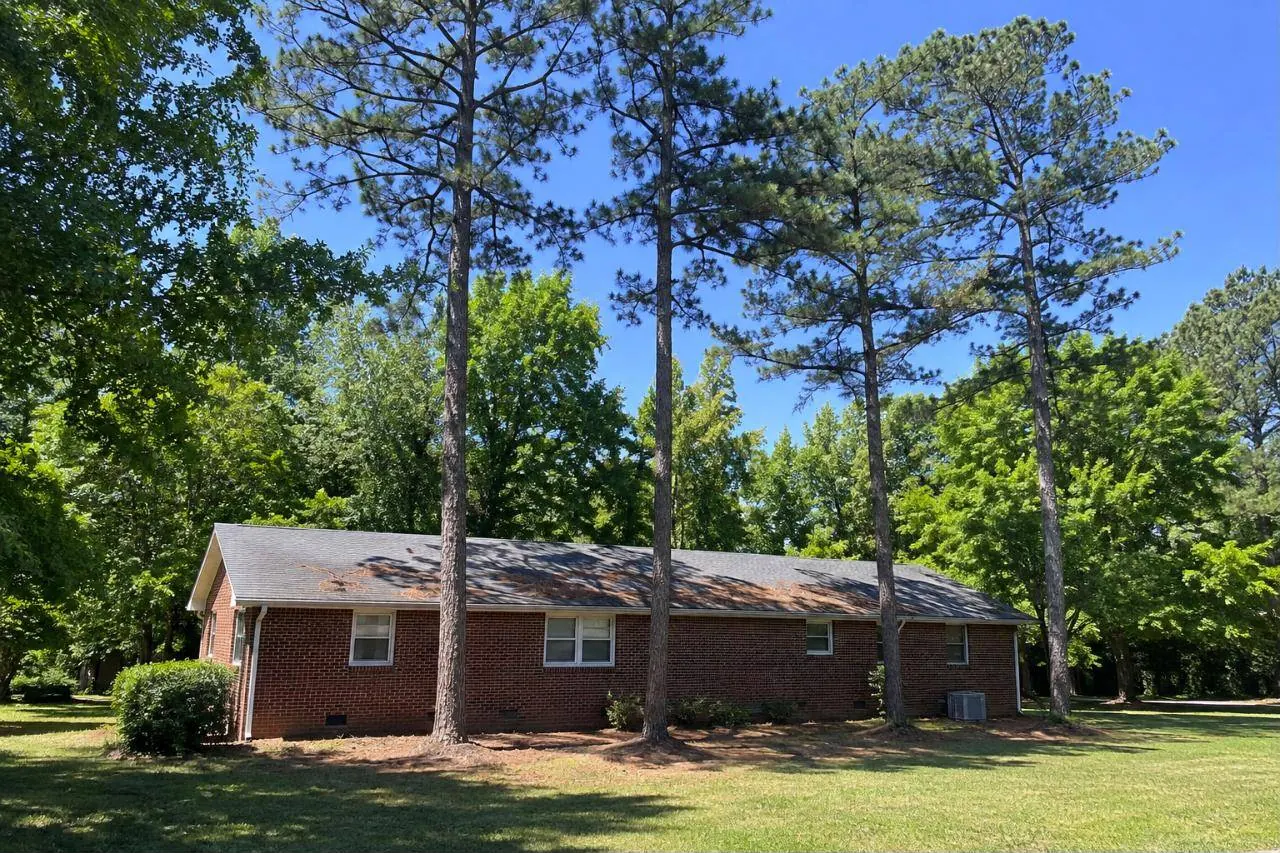
Which pines grow here
Two native pines come up most often in this guide.
- Loblolly pine. The North Carolina Native Plant Society calls it possibly the most numerous tree in the state, abundant across the Coastal Plain and the eastern 40 percent of the Piedmont, and gives its height as 72 to more than 100 feet.
- Virginia pine. A smaller, weedy pine, 36 to 72 feet, that comes up on nearly any kind of site. The same society lists it as abundant in the central and upper Piedmont and fairly common in the east-central Piedmont east to about Caswell and Randolph counties, but uncommon farther east toward the Fall Line, so around Louisburg it's less common than loblolly.
A 100-foot pine 40 feet from the house can reach the roof if it falls the wrong way. That simple arithmetic is behind most pine removal calls.
Ice, wind and clay
Loblolly's form works against it in winter. The Native Plant Society says it is very susceptible to breakage from ice and snow because of its straight branches. Central North Carolina has seen what that means: in the December 2002 ice storm, the State Climate Office reports a half inch to an inch of ice in a band across the Piedmont from Albemarle through Durham to Warrenton, nearly a million people without power in central North Carolina, and large trees and power lines brought down all across the area.
In hurricane winds, loblolly also does worse than its relatives. A 2017 N.C. Forest Service research summary on Hurricane Katrina reported 26 percent mortality for loblolly pine against 7 percent for longleaf, with slash pine in between, and concluded that longleaf is more resistant to wind damage than loblolly.
Roots matter too. The USDA Forest Service's species review says loblolly grows a taproot 4 to 5 feet long in deep sandy or loamy soil, but a much shorter, stouter one in clay. It calls the tree relatively windfirm where soils are deep, and says windthrow is common on shallow soils. By that account, a pine rooted in shallow soil has less holding it up in a storm.
Bark beetles
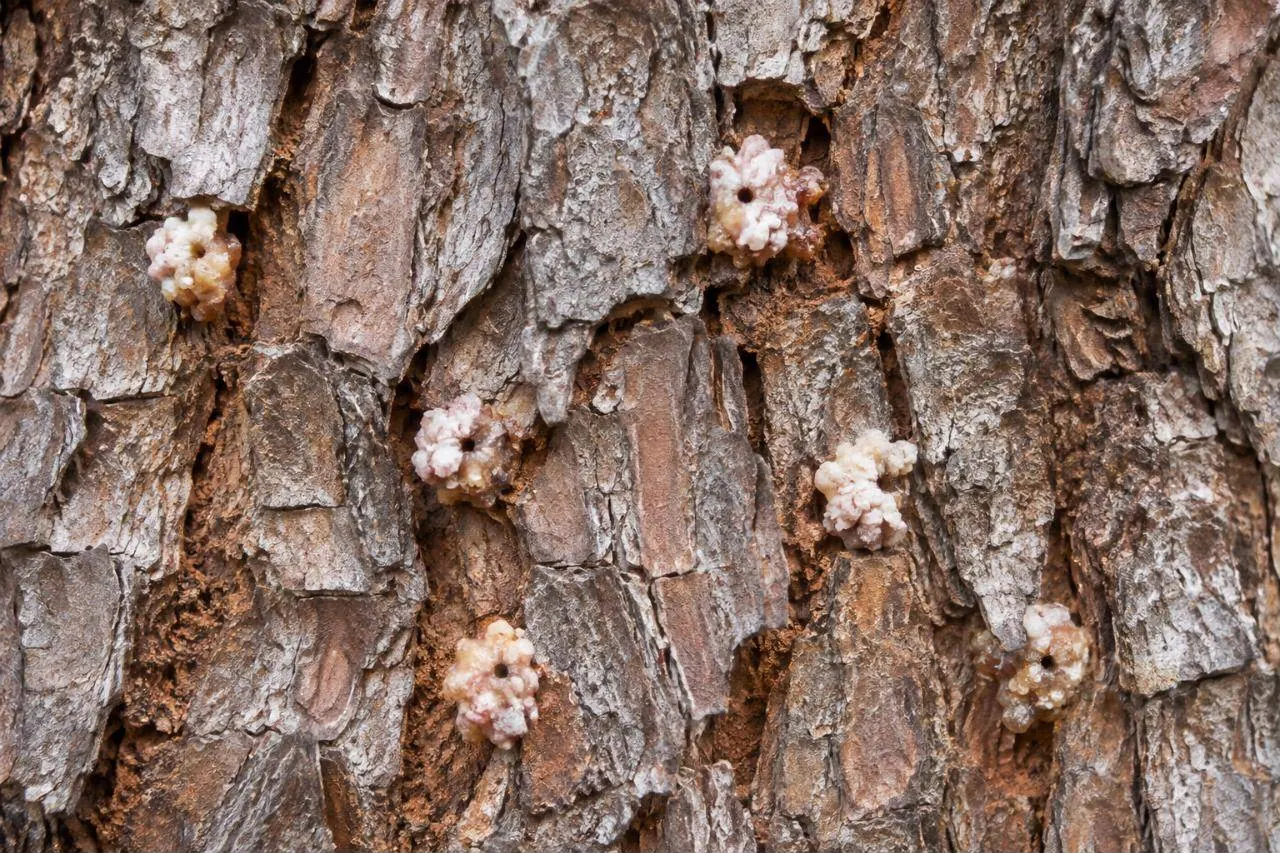
NC State Extension's guide to pine bark beetles lists three groups that attack southern pines: the southern pine beetle, Ips engraver beetles and the black turpentine beetle. It describes them as mainly attacking pines already stressed by something else, such as drought or disease. For Ips, the stresses include drought, overcrowded stands, storm or fire damage and lightning. The black turpentine beetle favors freshly wounded trees, including ones hurt by logging equipment or storms.
- Pitch tubes. Resin lumps on the bark, like the ones above, are a good sign that beetles are attacking, though they don't say which beetle.
- A fading crown. During an attack the needles go from green to light green, to yellow, to red.
- The southern pine beetle. The USDA Forest Service says loblolly is severely attacked by it, with infestations starting in stands stressed by fire, drought or logging.
What to do depends on scale. For a southern pine beetle spot in a stand, NC State describes cutting the infested trees along with a buffer of green trees around them. For Ips and black turpentine beetle, it says control is seldom warranted, though land managers may take out heavily infested trees to cut the risk to the trees around them. For a single beetle-killed pine near a house, the real reason to remove it is that a dead pine can fall. For a stand of pines bigger than a yard, the N.C. Forest Service's Franklin County office, (919) 496-3665, is a good first call.
Taking down a tall pine near a house
A pine is a long, straight trunk with most of its branches near the top, which makes the job different from taking down a spreading oak.
- Where there's room. With an open lane longer than the tree is tall, the pine can be notched and dropped whole, then cut up on the ground. With loblolly reaching 72 feet or more, that lane is longer than many owners expect.
- Next to the house. A climber or a bucket truck takes the crown off in pieces first, then works down the trunk in short sections, lowering heavy pieces on rope or dropping them into a clear spot.
- Dead or broken pines. A beetle-killed pine, or one with an ice-snapped top hung in the crown, needs extra care. Ask how the crew plans to handle it.
Ask where each piece will land, how the lawn, the septic field and the drive will be protected, and whether the stump will be ground. See stump grinding.
Wood, brush and pine straw
A big pine leaves a long trunk and a lot of brush. Louisburg's yard-waste crews take small branches cut to 4 feet and limbs up to 10 inches thick cut to 2 feet, but not logs over 10 inches. Its yard-waste containers do take pine straw and pinecones, and Youngsville's leaf program takes pine straw and cones too. Outside town limits there's no curbside pickup, so get hauling into the price or plan to deal with the logs yourself.
Burning a pile of pine brush is regulated: the state allows burning yard waste at home only where no public pickup exists, and a Forest Service permit is needed for fires in or near woodland between midnight and 4 p.m. See the burning rules.
Pines near wires
A tall pine beside the road often has distribution lines running past its crown. Louisburg Power keeps 15 feet of clearance around its lines and tells customers not to trim near them; Wake Electric says never to trim near lines yourself; Duke Energy says unqualified people should stay 10 feet from overhead lines under 50,000 volts. If the pine you want down is near a line, mention it when you call.
What pine removal costs
Thumbtack's national removal guide, updated March 24, 2026, prices by trunk diameter and canopy width, not height. A pine with a 12- to 24-inch trunk and a crown under 30 feet across falls in its $517 to $1,364 tier, and the same trunk under a crown wider than 30 feet in its $808 to $2,132 tier. What height changes is the method: a pine that has to come down in sections beside a house takes longer than one dropped whole in a field. Every figure is on what tree work costs.
What commonly goes wrong
- Waiting on a fading pine. Pitch tubes and a yellowing crown are the time to act; red needles are the last stage of the fade.
- Underestimating height. A pine that looks a safe distance from the house may not be.
- Forgetting the septic field. Trucks and log piles don't belong on drain lines, and 811 doesn't mark private systems.
- Leaving fresh wounds on the pines that stay. Black turpentine beetles favor recently wounded trees, so ask the crew to keep equipment off the trunks of the pines you're keeping.
- Burning in town. Where the town picks up yard waste, the state rule doesn't allow burning it at home.
Questions homeowners ask
Do I need a permit to cut pines on my lot?
For pines at an existing home, the town and county ordinances read for this site don't list one. Within 50 feet of a mapped stream or pond, check the state's stream buffer rule first (Tar-Pamlico, or Neuse in parts of the south of the county), and in Louisburg's historic districts ask Town Hall.
Should a pine with pitch tubes come down?
Not always. Pitch tubes mean beetles are attacking, and NC State notes that a lightly attacked tree may survive a black turpentine beetle infestation. Have it looked at, and watch the crown color.
Will removing some pines make the rest blow down?
That depends on the trees, the soil and what stands around them. Raise it with the contractor on site before deciding how many to take.
Can I keep the logs?
Usually. Say so up front, along with the length you want them cut to, and it should be reflected in the price.
Pine requests sent from here go to one independent contractor who works in Franklin County. This website has no crews or equipment.
- North Carolina Native Plant Society plant gallery: Pinus taeda; Pinus virginiana.
- N.C. Forest Service, Silvicultural Research in the News SRN-006, "Longleaf Pine is Resilient in the Face of Hurricane Winds" (July 14, 2017).
- USDA Forest Service, Fire Effects Information System, Pinus taeda (Carey, 1992).
- NC State Extension, Pine Bark Beetles (K. Oten, August 4, 2022). State Climate Office of North Carolina, December 4–5, 2002 winter storm event page.
- Town of Louisburg Solid Waste Collection Policy (2025); Town of Youngsville Solid Waste Services page; Louisburg Power Tree Trimming Policy; Duke Energy and Wake Electric tree safety pages. N.C. Forest Service, Franklin County contacts.
- 15A NCAC 02B .0734 (Tar-Pamlico buffers) and .0714 (Neuse buffers); Franklin County UDO, Article 9. Thumbtack, Tree Removal Cost Guide 2026, updated March 24, 2026.