
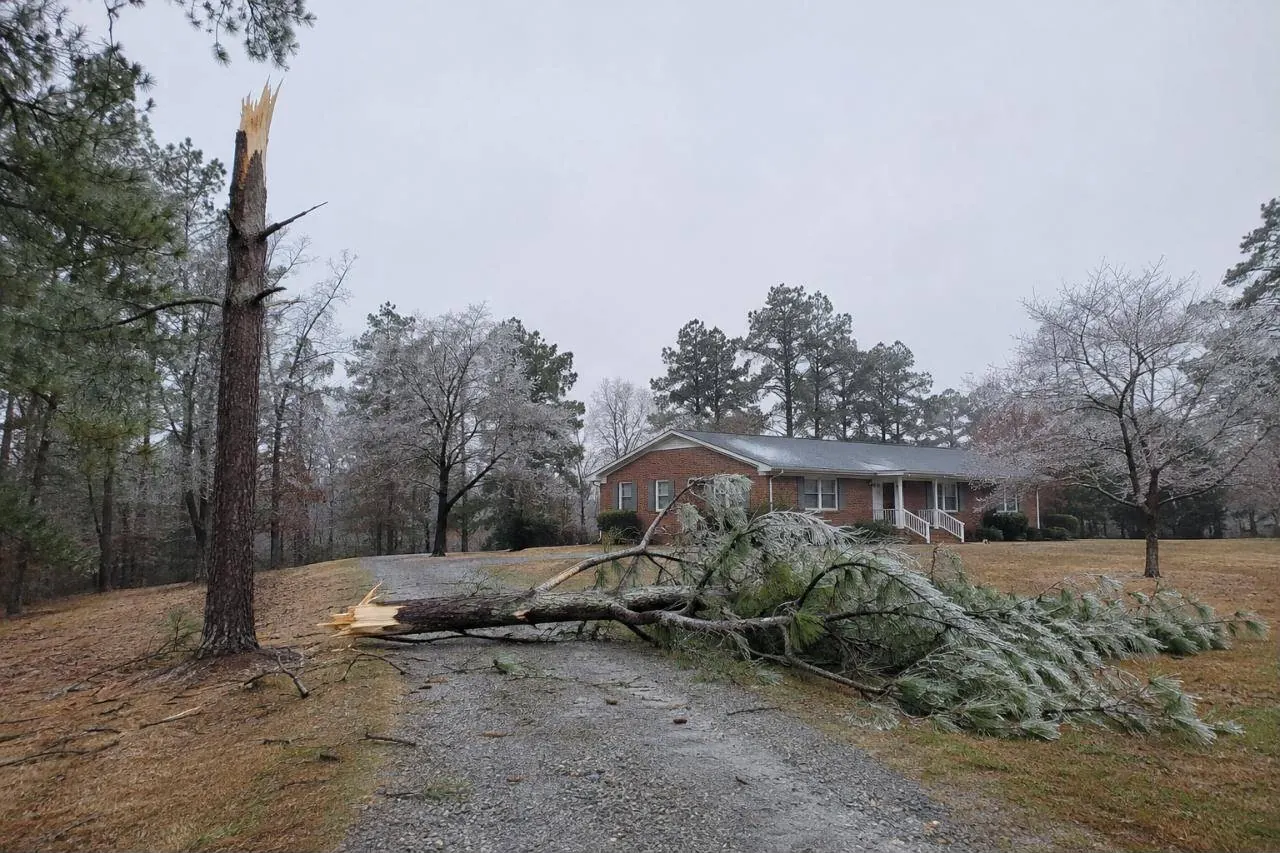
Why a fallen tree is an emergency
Falling trees kill people. A study published in Natural Hazards in 2009 counted 407 deaths in the United States from 1995 through 2007 caused by trees and limbs that failed in wind. Forty-four percent of the victims were in vehicles, hit by a tree or driving into one lying across the road. Another 38 percent were outside, and mobile homes and frame houses each accounted for 9 percent. Thunderstorms accounted for 41 percent of the deaths and high winds without a storm for 35 percent.
Central North Carolina knows this well. The State Climate Office of North Carolina counts 24 deaths in the state from Hurricane Fran in 1996, half of them from falling trees, and about 1.7 million customers who lost power. In the December 2002 ice storm, the N.C. Utilities Commission found that the great majority of power outages came from tree trunks or limbs falling onto distribution lines.
Franklin County has had its own close call. On August 8, 2024, the National Weather Service in Raleigh surveyed an EF-1 tornado that touched down about 6.8 miles east of Louisburg and tracked 2.9 miles, up to 125 yards wide, with peak winds put at 100 mph. Along the way, the survey says, numerous trees were snapped and uprooted, with the worst near the intersection of Hickory Rock Road and White Level Road. No one was hurt.
First steps when a tree comes down
- Get everyone away from the tree. A tree lying on a roof may move if the wind picks up, or as limbs are cut off it.
- Treat every wire as live. Duke Energy says to stay away from downed lines and anything touching them, trees and limbs included, and to report the hazard right away to the utility or to emergency services. Louisburg Power's after-hours line is (919) 496-4290. Wake Electric takes outage reports at (855) 280-1147. If anyone is hurt or trapped, call 911.
- Photograph before anything moves. The N.C. Department of Insurance tells storm victims to take pictures to document damage. Get the tree, where it came from, the roof, walls, porch, fence and car, and the inside of the house if water is getting in.
- Call your insurer. Ask what they need to see before the tree comes off. For questions about a claim, the Department of Insurance consumer line is 1-855-408-1212.
- Leave loaded wood alone. NC State Extension advises calling in professional help when there are bent or twisted branches under pressure that can kick back when cut.
- Then arrange the removal. Describe exactly what is lying on what when you call, and whether any wires are involved.
Who handles which tree
| The tree | Who to call | What the source says |
|---|---|---|
| From your yard, on your house | Your insurer, then a tree contractor | Standard policies generally cover the damage to the house when wind drops a tree on it (Insurance Information Institute, 2010) |
| From a neighbor's yard, on your house | Your own insurer | File on your own policy; your insurer may seek repayment from the neighbor's insurer, sometimes when the tree was in poor health or poorly kept (III, 2010) |
| On a power line | The utility | After storm outages, Duke Energy leaves cleanup to the property owner; Louisburg Power leaves storm limbs and debris on site and removes them as soon as reasonably possible |
| Across a state road | NCDOT | Report road problems at ncdot.gov/contact or through Customer Service, 1-877-368-4968 |
| On a Louisburg town street | Town Hall | (919) 496-3406 during office hours |
NCDOT's customer service line runs from 8 a.m. to 5 p.m. on weekdays, with longer hours when an emergency calls for them. A tree blocking a road at night is a 911 call if it's a danger to drivers.
How insurance usually treats fallen trees
The Insurance Information Institute set out the common pattern for standard homeowners policies in July 2010:
- Wind or hail drops a tree on the house. The damage to the structure and its contents is generally covered, and removal of the tree is generally covered up to about $500 to $1,000, depending on the insurer and the policy.
- A tree falls in the yard and hits nothing. There's generally no coverage for hauling it off, though some insurers pay to clear a tree blocking a driveway or a ramp built for someone with a disability.
- A neighbor's tree hits your house. The claim still goes on your own policy. If your insurer recovers from the neighbor's insurer, you may get your deductible back.
Policies differ, deductibles included. Read your declarations page, ask your agent, and keep every photo and invoice. A tree contractor can't tell you what your policy covers.
Storm debris
Outside a big storm, the towns' ordinary yard-waste rules apply: Louisburg's crews take limbs cut to set lengths and turn away logs over 10 inches and stumps, and the county has no curbside pickup at all. After a major storm, watch your town's announcements for special collections before you stack a mountain of brush at the road.
Burning storm debris is still regulated. Youngsville's code notes that the state Division of Air Quality, with approval, allows open burning of material from natural disasters such as hurricanes and tornadoes, but only with permission from the Division of Air Quality, the N.C. Division of Forest Resources and Youngsville Town Hall. Outside the towns, a Forest Service permit is needed for fires in or within 500 feet of woodland between midnight and 4 p.m., and a state ban issued by the Commissioner of Agriculture stops all open burning, permit or not. See the burning rules.
Price gouging after a declared emergency
North Carolina's Attorney General says that when a state of emergency is in effect, the price gouging law makes it unlawful for businesses or sellers to charge excessively high prices during the crisis. Report suspected gouging at 1-877-5-NO-SCAM (1-877-566-7226) or ncdoj.gov/pricegouging. The Attorney General's disaster repair advice adds: be wary of contractors going door to door, get a written contract listing all the work, don't pay for work up front, and pay by check or card rather than cash.
Common storm mistakes
- Sawing before taking pictures. Your insurer may want to see where the tree came to rest.
- Working near wires. Treat every line as live, whether or not your own lights are on.
- Cutting wood under tension. A trunk or limb pinned under weight can spring when the saw cuts it loose.
- Brush mixed with roofing or siding. Town yard-waste pickup is for plant material, and Youngsville's bulky-waste service won't take building materials from remodeling.
- A handshake price. Get the scope, price and cleanup in writing even when the job is urgent.
When this isn't the right guide
If the tree is still standing but worries you, see dead or leaning trees. If the storm has passed and you want to be ready for the next one, see tree trimming and Franklin County trees and storms. If someone is injured or pinned, call 911 before anything else.
Questions homeowners ask
Can I saw the tree off the roof myself?
Please don't. The weight of a tree on a roof is spread in ways that are hard to judge, and the wrong cut first can let it sink deeper into the house. NC State Extension points to professional help whenever bent wood under pressure or large equipment is involved.
Will insurance pay to remove the tree?
When wind drops a tree on an insured building, the Insurance Information Institute's 2010 guidance says removal is generally covered up to a limit, often about $500 to $1,000. A tree that lands in the yard without hitting anything generally isn't. Your own policy decides.
A pine is down across the road in front of my house. Is that mine?
If it's blocking a state road, report it to NCDOT, and to 911 if it's a hazard to traffic. If it fell from your yard and also damaged your property, talk to your insurer.
The power is out and a limb is on the line to my house. Can I pull it off?
No. Report it to your utility. Duke Energy says to keep away from downed lines and anything touching them, and Louisburg Power's policy tells customers not to trim trees near its lines.
Storm requests sent from this site go to one independent contractor in Franklin County. This website has no crews of its own.
- T. Schmidlin (2009), "Human fatalities from wind-related tree failures in the United States, 1995–2007," in the journal Natural Hazards, volume 50, pages 13–25.
- State Climate Office of North Carolina, "Then and Now: Fran a Standard-Bearer for Hurricane Destruction." N.C. Utilities Commission and Public Staff, Response of Electric Utilities to the December 2002 Ice Storm (September 5, 2003).
- National Weather Service Raleigh, public information statement on the Louisburg, Franklin County tornado of August 8, 2024.
- Duke Energy, Trees and Safety. Louisburg Power page and Tree Trimming Policy. Wake Electric, Vegetation Management. NCDOT contact directory and Customer Service contact page.
- N.C. Department of Insurance, storm preparedness release, August 8, 2023. Insurance Information Institute, guidance on insurance for fallen trees, July 22, 2010.
- NC State Extension, Preventing and Managing Storm Damage to Trees. Youngsville Code of General Ordinances, section 2.203. N.C. Forest Service, Open Burning Permits.
- N.C. Department of Justice, statewide price gouging release (January 10, 2025), Price Gouging Complaint page and Disaster Repair page.