
Is a permit needed?
For a yard tree at an existing house, usually not. Louisburg's zoning ordinance, in effect since January 15, 2025, has sections on buffer yards and screening, but no section on removing a tree from a home lot turned up when it was read for this site. Franklin County's Unified Development Ordinance sets buffer and planting rules for projects such as multifamily housing and manufactured home parks. Youngsville's general ordinances deal with trimmings left in the street, not with removal.
A few situations do call for a phone call before the saw starts:
- A house in a Louisburg historic district. The town runs a Certificate of Appropriateness process for its historic districts. Ask Planning, Zoning and Code Enforcement at Town Hall, (919) 496-3406, whether your job needs one.
- Trees near a creek or pond. The state's stream buffer rules cover 50 feet on each side of streams, lakes and ponds shown on the county soil survey or USGS maps: the Tar-Pamlico rule over most of the county, the Neuse rule in parts of the south. Each rule's table of uses decides which removals are allowed. A buffer permitting specialist at the Division of Water Resources is at (919) 707-3631.
- Clearing a lot to build. Grading and clearing for new construction is a development matter. Franklin County Planning: (919) 496-2909.
- A tree on the road's edge. A tree in the right-of-way of a state road is an NCDOT question. NCDOT Customer Service: 1-877-368-4968.
Burning, curbside pickup and the rest are on the Louisburg rules guide.
How the tree comes down
A wooded lot out in the county may have room to drop a tall tree whole. An in-town lot with a neighbor's roof on one side and the service line on the other usually doesn't. A crew picks among three approaches.
- Dropped whole. With an open lane longer than the tree is tall and nothing in it, the cutter notches the side the tree should fall toward and makes a back cut on the other. It's the quickest way and needs the most clear ground.
- Taken apart. Over a house, a porch, a shed, a fence or the wire to the house, a climber or bucket truck strips the limbs, then brings the trunk down in short sections, lowering heavy pieces on rope.
- Lifted out. A big tree leaning toward the house with nowhere to set pieces down may come out in sections on a crane. Whether a crane can set up depends on the drive, how soft the ground is, and the wires overhead.
Ask which approach is planned and where each piece will land. That one answer shapes most of the price and most of the risk to your property.
Logs, brush and the curb
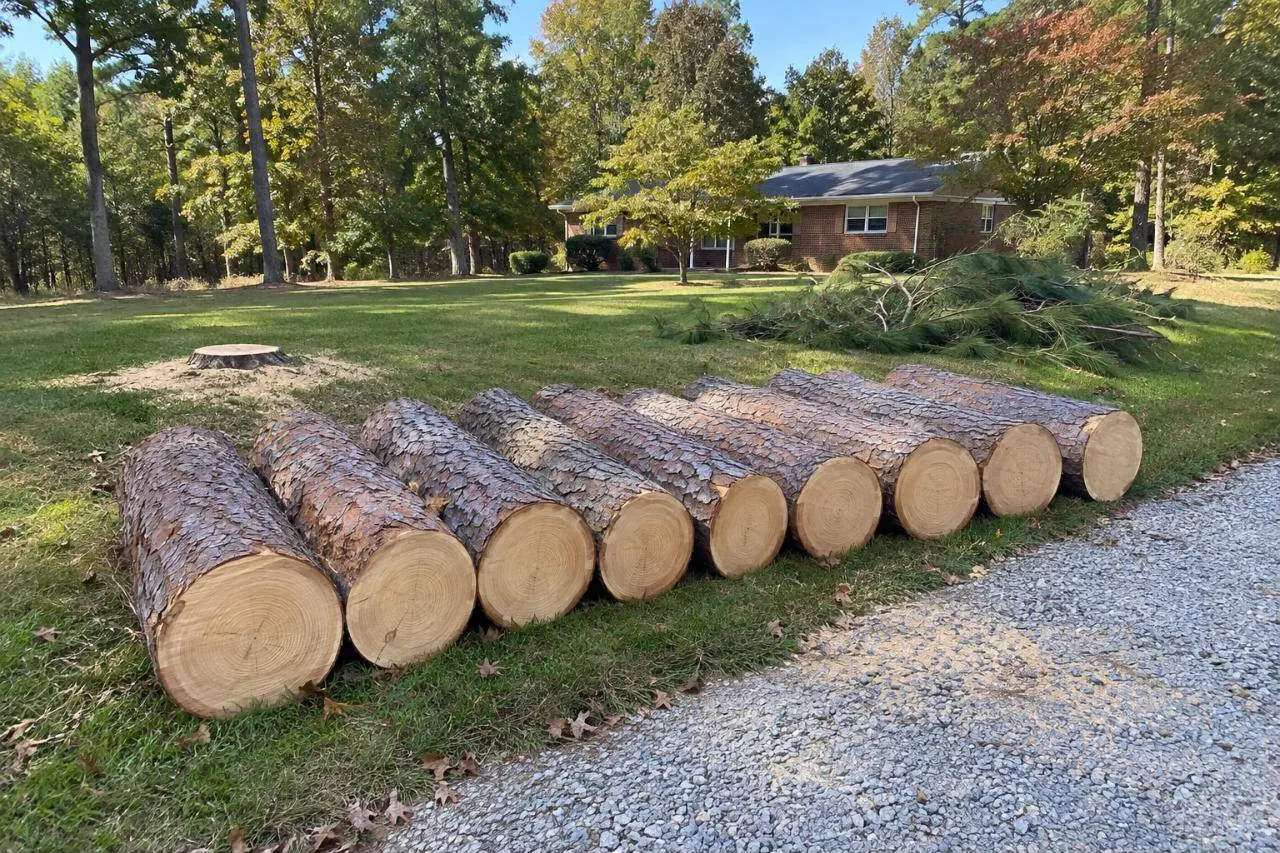
A single large oak or pine leaves more wood than Louisburg's yard-waste crews will take. The town's solid waste policy, adopted August 12, 2025, accepts small branches 1 to 4 inches thick cut no longer than 4 feet, and limbs 5 to 10 inches thick cut no longer than 2 feet, set behind the curb. It turns away logs over 10 inches across, stumps, large root balls and whole bushes. A brush pile bigger than the containers hold, up to 4 cubic yards, is collected on your regular yard-waste day only after you call Town Hall at (919) 496-3406 to schedule it.
The same policy says that when a resident hires out construction or landscape work, the contractor or the resident gets rid of the waste. Franklinton's public works page is blunter: brush from a contractor's work has to be disposed of by the contractor, at the resident's expense. Outside town limits, Franklin County doesn't collect waste at the curb at all; its transfer station at 5 Landfill Road takes yard waste, with tipping fees.
So the written price should say what leaves your lot:
- Everything chipped and hauled off, and the lawn raked.
- Brush chipped and hauled, logs cut to length and stacked for you.
- Chips dumped where you want them for mulch or a path.
- Logs left where they fall, for you to deal with later.
Burning the brush has its own rules, and inside the towns it isn't allowed. See burning and pickup.
Wires in or near the tree
Louisburg Power's tree trimming policy, adopted August 12, 2025, asks for 15 feet of clearance around its lines and tells customers not to try trimming any tree near one. Wake Electric tells members never to trim branches near lines themselves. Duke Energy says an unqualified person shouldn't work within 10 feet of overhead lines carrying under 50,000 volts, and asks owners to have the line to the house de-energized before tree work. If wires run through the tree you want gone, say so when you call; it changes who handles which part of the job. More on trimming near lines.
The stump
Unless the price says otherwise, a removal leaves a stump. Having it ground on the same visit saves a second trip for the machine. North Carolina's dig law defines excavation broadly, as moving or removing earth, rock or other material in or on the ground, and expects notice to NC 811 three full working days ahead. See stump grinding.
Where removals go wrong
- Forgetting the wires. The service drop to the house, and lines out to a shop or barn, often pass through limbs.
- No plan for the logs. Louisburg won't collect logs over 10 inches, and the county has no curbside pickup.
- Burning in town. The state allows yard-waste burning at home only where there's no public pickup.
- Cutting by the creek. The state's 50-foot stream buffer rules (Tar-Pamlico, or Neuse in parts of the south of the county) reach out from mapped streams and ponds.
- Forgetting the septic field. 811 locators don't mark private systems, so show the crew where the tank and drain lines are before trucks and loaders roll in.
- Nothing in writing about cleanup. Without it, the wood pile may stay yours.
What removal costs
Thumbtack's tree removal cost guide, last updated March 24, 2026, gives $450 to $1,450 as the national range to cut down a single tree, and $884 to $1,627 with the stump taken out too. It sorts prices by trunk diameter and canopy width. A trunk under 12 inches with a crown under 30 feet across runs $226 to $596; a 24- to 36-inch trunk with a crown wider than 30 feet runs $1,562 to $4,117. Those are national figures, not Louisburg prices. Every number, with its date, is on what tree work costs.
When this isn't the right guide
If the tree is healthy and only crowding the roof or the drive, trimming may solve it; see tree trimming. If a storm has already put it on the house, start with storm and emergency removal. If the tree is a pine near the house, the pine guide goes further. Clearing acreage for a new house is land clearing, a bigger job that starts with the county or town planning office.
Questions homeowners ask
Does the Town of Louisburg have to approve removing my tree?
No approval for a yard tree at an existing home turned up in the town's posted zoning ordinance. The ordinance does require a zoning permit before land is disturbed, so if the house is in a historic district, or the work involves grading or digging out roots, ask at Town Hall first: (919) 496-3406.
Will the power company take a tree off the line?
Louisburg Power will trim a limb lying on a service drop when asked, but its crews won't clean up or haul the limb off. It removes trees rooted in its right-of-way as scheduling allows. It will take out a tree on private property only if the tree is an ongoing problem or a severe threat to the power grid, and then only on a staff recommendation, with Town Council approval and a signed release. Duke Energy says the property owner has primary responsibility for keeping the line to the house clear.
Who hauls the wood?
Whoever the written price says. Louisburg's policy puts waste from hired landscape work on the contractor or the resident, so settle it before the job starts.
How long does a removal take?
That depends on the tree, the access and what's underneath. Dropping a tree whole in an open yard goes faster than taking one apart over a roof. Ask the contractor for a time frame along with the price.
Requests from this page go to one independent contractor who works around Louisburg. This website cuts no trees.
- Town of Louisburg Consolidated Zoning Ordinance (effective January 15, 2025); Planning, Zoning and Code Enforcement page; Solid Waste Collection Policy (adopted August 12, 2025, effective October 6, 2025); Louisburg Power Tree Trimming Policy (adopted August 12, 2025). Read November 2026.
- Franklin County Unified Development Ordinance, Article 5; Franklin County Trash and Recycling and Convenience Sites pages. Town of Franklinton Public Works page. Youngsville Code of General Ordinances (August 2026).
- 15A NCAC 02B .0734 (Tar-Pamlico riparian buffers); 15A NCAC 02B .0714 (Neuse riparian buffers); Franklin County UDO, Article 9. N.C. General Statutes Chapter 87, Article 8A. NC811, "The 811 Process."
- Duke Energy, Trees and Rights-of-Way FAQ. Wake Electric, "Spring into Safety" (April 6, 2026).
- Thumbtack, Tree Removal Cost Guide 2026, updated March 24, 2026.