
Tree permits: what the ordinances say
- Town of Louisburg. The consolidated zoning ordinance, effective January 15, 2025, has sections on buffer yards (Sec. 21-373) and screening (Sec. 21-380), which come into play with development. No section on removing trees from a home lot turned up when it was read for this site. The ordinance does require a zoning permit before land is disturbed; if roots or a stump will be dug out, ask the zoning office whether that applies. The town also has historic districts with a Certificate of Appropriateness process; if your house is in one, ask Planning, Zoning and Code Enforcement whether tree work needs approval. Town Hall: (919) 496-3406.
- Franklin County. The Unified Development Ordinance, first adopted in 2001 and updated in 2021, sets buffers and plantings for things like multifamily developments, manufactured home parks and some commercial uses. The parts read for this site don't list a permit for a homeowner removing a yard tree. Planning: (919) 496-2909. Inspections: (919) 496-2281. The office is at 127 S. Bickett Boulevard in Louisburg.
- Youngsville. The town's Code of General Ordinances, as updated in August 2026, makes it unlawful to put tree or shrub trimmings on a street or sidewalk, and it covers burning (below). Development rules are separate. Town Hall: (919) 925-3401.
- Franklinton and Bunn. Franklinton Planning: (919) 339-0261. Bunn Town Hall: (919) 496-2992.
If anyone tells you a permit is required for your job, ask which office issues it, and call that office yourself.
Burning brush: two sets of rules
Two state agencies regulate burning a brush pile, and both apply at once.
The N.C. Forest Service requires a permit for any fire in woodland under its protection, or within 500 feet of that woodland, between midnight and 4 p.m. The Forest Service says burn permits "don't cost anything." Get one online at ncforestservice.gov/burnpermits, or in person from the Franklin County office or a local permitting agent. The county office is at 2177 Fire Tower Road, about 4 miles northeast of Louisburg off State Road 1002: (919) 496-3665. When the Commissioner of Agriculture issues a statewide ban, all open burning stops, permit or not. Franklin isn't on the state's list of high-hazard counties, which have stricter permit rules. Burning without a required permit is a Class 3 misdemeanor under state law.
The N.C. Division of Air Quality sets what may be burned and where, under rule 15A NCAC 02D .1903. For a home, burning leaves, branches and other yard waste is allowed only when all of these hold:
- The material came from that residence and is burned there. The Division says residents can only burn vegetation from their own yard.
- No public pickup service is available.
- The fire is lit no earlier than 8 a.m., and nothing is added between 6 p.m. and 8 a.m. the next day.
- The day's air quality forecast is Code Green or Code Yellow. Burning on Code Orange, Red or Purple days is prohibited.
- Nothing man-made goes on the pile: no trash, lumber, treated wood, shingles, tires or plastics. The Division's rule of thumb is "If it doesn't grow, don't burn it."
- Local ordinances allow it, and no burn ban is in effect.
Violations can bring fines of up to $25,000, the Division says. Bigger land-clearing burns have their own rules, including keeping piles at least 500 feet from occupied buildings off the property and 250 feet from a public road when the wind blows toward it.
How it plays out at three addresses
- An in-town house in Louisburg, Youngsville or Franklinton. The town picks up yard waste, so the state's "no public pickup" condition generally isn't met; for stumps or logs the town won't take, ask the town before burning. Youngsville's code also bans burning leaves, branches and other plant material the town collects. Use the town pickup, or have the contractor haul it.
- A county lot at the edge of the woods. No public pickup, so the state's home-burning conditions can be met. Because the pile is within 500 feet of woodland, a Forest Service permit is needed before burning between midnight and 4 p.m.
- A county lot in open pasture, far from any woods. The state's air rules still apply. Whether the Forest Service permit applies depends on the distance to woodland, so check with the Franklin County office.
Yard-waste pickup in each town
| Where | Pickup | Size limits | Not taken |
|---|---|---|---|
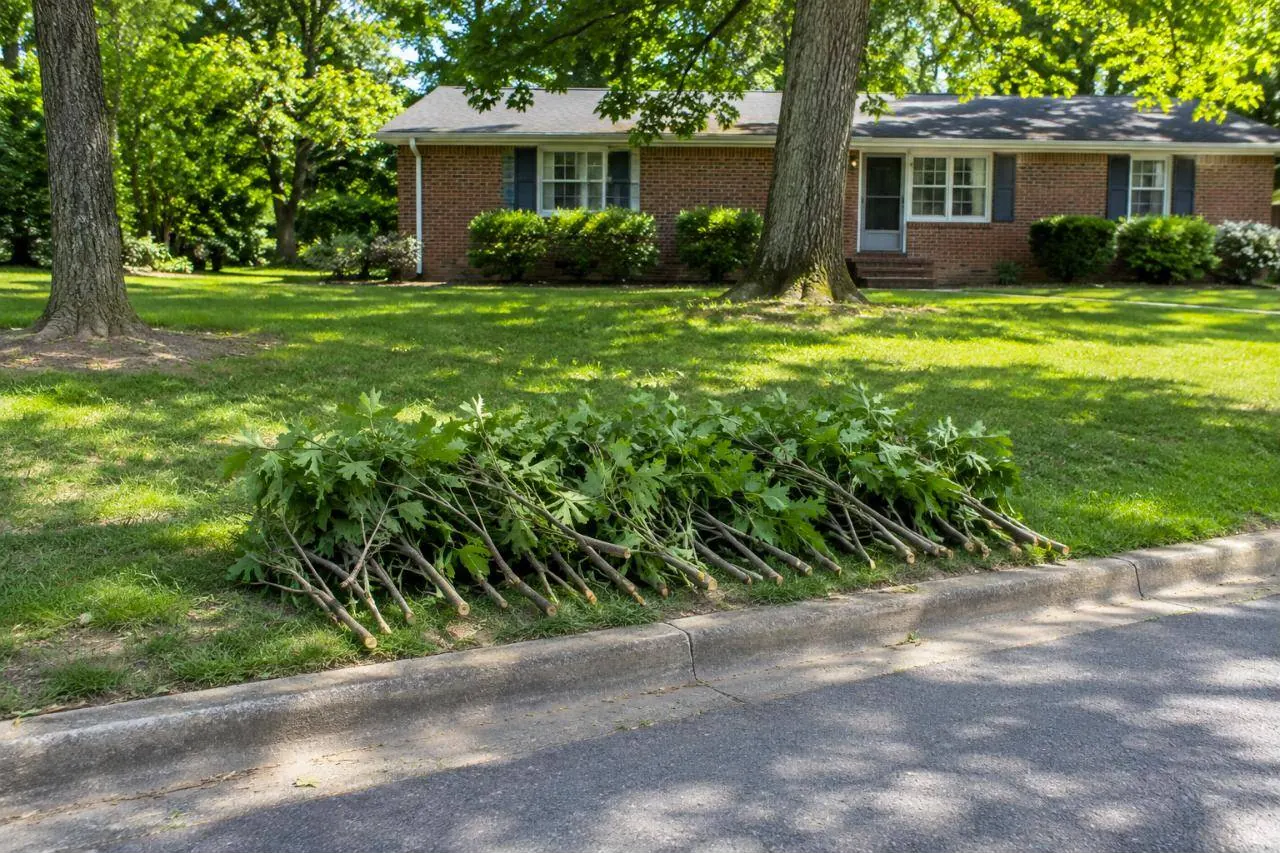
| Louisburg (919) 496-3406 | Wednesday, Route A (north); Thursday, Route B (south) | Branches 1–4 in. thick up to 4 ft long; limbs 5–10 in. thick up to 2 ft; large brush up to 4 cubic yards, cut to 4 ft and stacked behind the curb, by scheduled request | Stumps, large root balls, entire bushes, logs over 10 in. |
| Youngsville (919) 925-3401 | Mondays, and Thursdays if needed | Up to 4 cubic yards; nothing over 5 ft long | Bagged leaves and grass |
| Franklinton (919) 494-2520 | Thursdays | Up to 6 ft long and 6 in. thick | Stumps |
| Outside town limits | No curbside collection by the county | The county transfer station at 5 Landfill Road takes yard waste; tipping fees apply |
Loose leaves have their own seasons: November 1 to February 1 in Louisburg, November through January in Youngsville, and October into January in Franklinton (the town's page also says loose leaves need no bag through the end of February, so call to confirm). Louisburg asks that leaves go behind the curb, not in the street or gutter, and at least 8 feet from cars, mailboxes, trees and shrubs.
Hired work is treated differently. Louisburg's policy says that when a resident contracts construction or landscape work, the contractor or resident disposes of the waste. Franklinton says brush from a contractor's work must be disposed of by the contractor, at the resident's expense. Put hauling in the written price.
Trees and power lines
- Louisburg Power. Its Tree Trimming Policy, adopted August 12, 2025, sets a 15-foot clearance from its line right-of-way and gives the utility authority to clear hazards with standard pruning methods. It removes trees rooted in its right-of-way as scheduling allows. A tree on private property comes out only if it's an ongoing problem or a severe threat to the power grid, and then on staff recommendation, with Town Council approval and the owner's signed release of liability. It also tells customers to call NC 811 before planting, to find underground lines. After hours: (919) 496-4290.
- Duke Energy. The property owner has primary responsibility for keeping the line to the house clear, and Duke asks owners to have that line de-energized before tree work.
- Wake Electric. Its vegetation program includes removing hazard trees within its rights-of-way. Members with an immediate concern can call (919) 863-6300 or (800) 474-6300.
Trees along roads
A tree in the right-of-way of a state road falls under NCDOT, so ask before cutting it. NCDOT's Franklin County maintenance unit is on Highway 39 South in Bunn, and questions go through NCDOT Customer Service at 1-877-368-4968 or ncdot.gov/contact. On town streets, call the town. And wherever you are, keep trimmings off the pavement: Youngsville's code makes leaving them on a street or sidewalk unlawful, and Louisburg wants yard waste behind the curb, clear of obstructions.
Creeks, ponds and the stream buffer rules
Franklin County's own ordinance notes that most of the county is in the Tar-Pamlico River Basin, with a small part of the south in the Falls Lake watershed of the Neuse. The state's Tar-Pamlico buffer rule, 15A NCAC 02B .0734, protects a 50-foot strip on every side of intermittent and perennial streams, lakes and ponds that appear on the county soil survey or USGS maps: an inner zone of 30 feet and an outer zone of 20.
- Existing lawns are grandfathered. A maintained lawn, which the rule describes as one that can be mowed without a chainsaw or bush hog, counts as an existing use if it was there by January 1, 2000.
- Tree removal has its own entries. The Tar-Pamlico rule's table of uses lists removal of individual dead, diseased or damaged trees, and of trees in danger of damaging homes, along with pruning and other woody vegetation work, each with conditions.
- Ask before cutting. A buffer permitting specialist at the Division of Water Resources: (919) 707-3631.
DEQ lists the Neuse basin among those with a buffer rule of its own, 15A NCAC 02B .0714, which also protects 50 feet. If your land is in the south of the county, around Youngsville, ask DWR whether the Neuse buffer rule applies instead.
Digging and grinding: NC 811
State law expects notice to NC 811 at least three full working days before excavation; weekends and state holidays don't count. Call 811 or 1-800-632-4949. Utilities mark public lines, but NC811 says private lines on private property aren't marked, and where they don't encroach on a utility's right-of-way or easement, septic tanks and irrigation systems fall outside the law's definition of an underground facility. See stump grinding.
Questions homeowners ask
Is a dead tree an exception to anything?
The town and county ordinances read for this site don't list a yard-tree permit to begin with. Near a creek or pond, the buffer rule has a specific entry for dead, diseased or damaged trees.
Can I burn the brush from a tree removal?
Inside the towns, generally not; the state rule requires that no public pickup be available, and the towns pick up brush. In the county, yes, if the state air conditions are met and you have a Forest Service permit when one is required.
Who do I call about a tree in the road?
NCDOT for a state road, the town for a town street, and 911 if it's a danger to traffic.
What if I have more brush than the town takes?
Louisburg's scheduled large-brush pickup tops out at 4 cubic yards, about one pickup truck load. For bigger piles, the town has a truck residents can use, billed at $100 per use, payable when you request it. Or have the contractor haul it.
This site sends each request to one independent contractor around Louisburg. It doesn't apply for permits or do tree work.
- Town of Louisburg: Consolidated Zoning Ordinance (effective January 15, 2025); Planning, Zoning and Code Enforcement page; Solid Waste Collection Policy (adopted August 12, 2025); Louisburg Power Tree Trimming Policy (adopted August 12, 2025). Read November 2026.
- Franklin County: Unified Development Ordinance cover, Articles 5, 9 and 10; Planning and Inspections directory; Trash and Recycling and Convenience Sites pages.
- Town of Youngsville Solid Waste Services page and Code of General Ordinances (August 2026), sections 2.201, 2.203 and 3.302. Town of Franklinton Public Works and Planning pages. Town of Bunn home page.
- N.C. Forest Service, Open Burning Permits and Franklin County contacts. N.C. General Statutes 106-942, 106-943 and 106-948.
- N.C. Department of Environmental Quality, Open Burning; 15A NCAC 02D .1903.
- 15A NCAC 02B .0734 (Tar-Pamlico buffers) and .0714 (Neuse buffers); DEQ buffer rules brochure and 2020 buffer rule update fact sheet; DEQ, Falls Lake nutrient strategy status report (2016). N.C. General Statutes Chapter 87, Article 8A; NC811.
- Duke Energy, Trees and Rights-of-Way FAQ. Wake Electric, Vegetation Management. NCDOT directory.